Showing posts with label data. Show all posts

Big Data Can Be a Big Deal, If It’s a Big Mess

We create 2.5 quintillion or 2,500,000,000,000,000,000 bytes of data every day!

Data is available everywhere today, making it even more important to know:
  • Why you need it, 
  • How will it help, 
  • Who will it help, 
  • What it will cost to capture and analyze, 
  • What return you can get out of it.
Big Data is invaluable information about your customers. This data is gathered from various sources such as social channels, ICT networks, videos, digital images, GPS signals, and basically any device or software customers use to interact with each other and brands. Big data is important as it provides an inside view of your target market, their preferences, behavior and opinions. 

There is no limit to the availability of information and harnessing huge volume of data can be a challenge. Creating a customer profile and goal based on every data source is surely not the way to go. The best way to tackle the beast is to set defined goals and objectives first. 

The mantra with Big Data is “If you don’t know what you are looking for, you will never find it.”

Make your business 
More Agile
More Flexible 
More in tune with your customers

With Big Data

http://infocheckpoint.wufoo.com/forms/i-want-to-know-more/

Your Data Is Going Stale…Every Minute! Know if Your Data Stinks

As any other corporate asset, data is valuable and equally responsible for providing your business with a competitive edge. 

Data quality is not only about a score on accuracy or number of null entries in the database, or the number of fields and addresses that are incorrect. Data quality refers to the level of fitness it possesses with reference to the end use for which it was created. 

Think about it…
  • A new business opens every minute,
  • A CEO changes every minute,
  • A company name changes every 2 minutes,
  • A business closes every 3 minutes.
With business information changing by the minute, updating data is critical in determining the success of your marketing campaigns and strategic decision. The important aspects of data quality include accuracy, completeness, correctness credibility and currency.
Get to know if your data stinks….


Wish to see what results quality data can produce

What’s Motivating Your Brand? Learn from the 'Billion Dollar Hippy'

We all have times when we are insanely motivated and times when we find every excuse to pin down our lack of motivation. The solution is to get started on that list of ‘things to do’. A small step every day towards accomplishing your goals will eventually lead to fulfillment.

Let us apply this to our brands. What is motivating your brand? What do you do every day, every minute  to make your brand a better experience for your customers?

The core of Info CheckPoint is data…and quality. What continuously motivates us is to relentlessly maintain quality and deliver accurate, current and relevant data to users. For us data is about:
  • Accuracy – Contact details such addresses and phone numbers are verified and are associated with the person or business in the record.
  • Freshness – Information reflects current details of the person or business.
  • Completeness – All records are complete making it valid for relevant usage.
  • Uniqueness – There is only one record per person or business and duplicate records are merged or deleted.
  • Standardized – Information recorded follows a set format and standard.

For us Data Quality is a discipline not a task
It’s a statistic to state
It’s a practice we follow!
Access sales-ready prospects with Info CheckPoint on Salesforce

Check out this beautiful BBC documentary on ‘Steve Jobs - Billion Dollar Hippy’ – nothing else can be more motivating.

Spend $1 on Quality Data than $100 on Bad Data!

  • 80% of companies have phone records with “risky” connectability 
  • 60% of companies had an “unreliable” score of overall heath 
  • 25% of companies have inaccurate B2B databases
Source: - Sirrus Decisions

According to Forrester, only 12% of companies rely on intelligence from quality data. And this could cost companies an estimated $8.2 million a year, according to Gartner. Would you rather spend $100 on correcting bad data or $1 on verifying the record before getting it entered?

Data quality is subjective!

It need not necessarily be about the number of incorrect fields, the percentage of addresses that are incorrect, a score on accuracy or number of null entries in the database. It is about the level of fitness it possesses in context with the end use for which it was created. Data quality is about correctness, accuracy, completeness, currency and credibility.

It’s no secret, here’s how often we update our data:
https://www.infocheckpoint.com/UsersAccount/UserRegistration.aspx

Every Minute 

  • New contacts are added and updated, 
  • 1.2 million records are televerified, 
  • Social media links are added, 
  • Contacts with duplicate names are removed from the database (1 million records)
Every Month 

  • 160K direct dial numbers are added, 
  • All 20 million records are verified and results are updated, 
  • Ping test for all 20 million is done to ensure there are no spam traps and syntax errors, 
  • Email campaign results (click rates, open rates, opt-in, opt-out and bounce rates are updated with the date of verification)
Let quality data provide you with competitive edge, 
Make it your most valuable corporate asset!

Don’t Let Dead Data Kill Your Campaigns!

• A new business opens every minute 
• A CEO changes every minute 
• A company name change occurs every 2 minutes 
• A business closes every 3 minutes 
• A new business files for bankruptcy every 8 minutes 

So, are you keeping up with these changes? When was the last time you updated and cleaned your database? 

In order to gain ROI on data investment, it should be accurate, complete, correct, current and credible. What poor data quality does is it increases your marketing and operating costs.  

We take our data seriously!


Spend $1 on Quality Data than $100 on Bad Data!

• Only 12% of companies rely on intelligence from quality data, according to Forrester. 
• This could cost companies an estimated $8.2 million a year, according to Gartner!
• Would you rather spend $100 on correcting bad data or $1 on verifying the record before getting it entered?

Data quality is subjective!

It need not necessarily be about the number of incorrect fields, the percentage of addresses that are incorrect, a score on accuracy or number of null entries in the database.

It is about the level of fitness it possesses in context with the end use for which it was created. Data quality is about correctness, accuracy, completeness, currency and credibility.


Data Quality Cheat Sheet from InfoCheckPoint

Let quality data provide you with competitive edge, make it your most valuable corporate asset! Access this quick Data Quality Cheat Sheet!

Spend Marketing Dollars on Data that Counts!

Don’t Just Mine Data, Mind It and Make It Work!

Are contacts and email addresses verified and validated?
Is data contributing to the success of your campaigns?

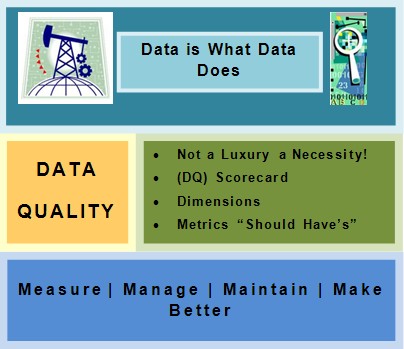
Any data intensive business will need to answer such basic questions to make better decisions and gain a bigger picture. With data quality, some of the ‘should have’ metrics are definition, relevancy, currency, measurability, traceability and controllability.

The objective of assessing data quality is not necessarily to identify errors. Quality teams can spend months designing rule books and error reports, however the real ROI from assessment initiatives is justified by developing a data quality scorecard. By creating scores for each data quality dimension, measurable metrics can be identified to add value to data quality management.

As they say, “the devil is in the details”, a clear approach in defining data quality metrics is:
1. Identify and select one aspect of business impact related to bad data quality.
2. Assess data dependencies related to that aspect of business impact.
3. List related data expectations of business clients related to each data dependency.
4. Determine data quality dimension for each data expectation.
5. Specify business rules to establish conformance of the data quality with expectations.
6. Ascertain a process of measuring conformance and establish an acceptability threshold for each business rule.

What a data quality scorecard does, is it provides an analytical tool to determine ROI on initiatives as well as the cost of bad data.

Measure it, Manage it, Maintain it and Make it Better. Develop an insightful Data Quality (DQ) Scorecard.

Poor B2B Data Costs the US Economy!

Think data is free? Do you know how much poor B2B data costs the US economy?
A staggering $3.1 trillion a year!                                              Source: A recent report by Artemis Ventures

Data Quality
It may be difficult to foresee changes in the economy, but your data can make predictions for your business! With quality data you can measure relevancy, analyze effectiveness, optimize strategies and maximize revenues and ROIs. 

Quality data is the foundation for making critical business decision. Any data intensive organization will agree with that! However, how many assume that their data is of good quality without measuring it with quantifiable metrics?

There is a famous saying that, “What is not measured is not managed”, and what is not managed is surely not possible to maintain or improve. To begin with you need to know your data quality dimensions and metrics.

Get to know how you can measure data with the Data Quality (DQ) Scorecard. 

Don’t let Data Quality affect your Bottom Line. 

Size Does Matter…With Big Data at Least!

Let us first clarify what ‘Big Data’ is and what the buzz around it is about.

Big Data is information about customers available through various sources and channels, from social and ICT networks, from videos and digital images, from sensors or GPS signals, to name a few. This data is something which can be invaluable for businesses. 
big data, database marketing
So why are people getting ‘buzzy’ about Big Data? 
Because it is the biggest source for marketers to gain real-time and in-depth insights into the preferences and behavior of their customers. 

How does Big Data help? 
It helps in creating targeted marketing campaigns. To give customers what they need more than what they want. While you may think this applies mainly to B2C companies you are mistaken, as B2B companies need to consider their clients’ businesses as individual personas as well.

Ask CMOs what defines a successful brand? And they will tell you it is primarily in using customer data to drive marketing decisions and ROI. What better way to obtain customer data than through social media channels. And yet, of around 85% of companies that use social media as a marketing tool, only 19% collect data from these channels! 

The best way to create brand awareness, build brand association and increase engagement is in conversing with customers, personally. Mass media marketing tactics for sure don’t work in social channels.

Your next marketing plan should go regional rather than national; it should go into sub verticals, into personas rather than demographics and focus on specific stages in the buying cycles. Your database of customers should be segmented to identify groups to enable targeted communication. 

This is where Info CheckPoint comes in by providing segmented databases that are socially integrated including LinkedIn profiles with every contact. 

So go get started, drill down, target, personalize and increase marketing ROI!

Psst - While size does matter, so does the quality of experience!

Business Model of infoCheckPoint is Conceptualized on Crowdsourcing

CrowdSourcing : This Is The Future 
Tasks traditionally performed by an employee or contractor, when outsourced to a crowd or large community through an open call are known as Crowdsourcing. Public is invited to carry out tasks, write their views or help in developing a new technology through Crowdsourcing.

People come together to contribute to such platform either due to their deep personal interest or some another kind of motivation. Usually there is some barter that motivates concerned people to opt for this mutually beneficial scheme. Wikipedia is an excellent example of Crowdsourcing.

Info CheckPoint’s Fresh Thinking

Info CheckPoint’s model is also based on this proven concept. Individual users, SOHOs, medium sized and large companies happily contribute to our database by sharing their data records and in turn gain access to huge data pool of Info CheckPoint.

Validated Crowdsourced Data

The added advantage is that we verify each and every data that is uploaded to the site, in order to ensure its validity. Thus, Info CheckPoint users get hassle free, fresh, and validated prospect database at their fingertips.